
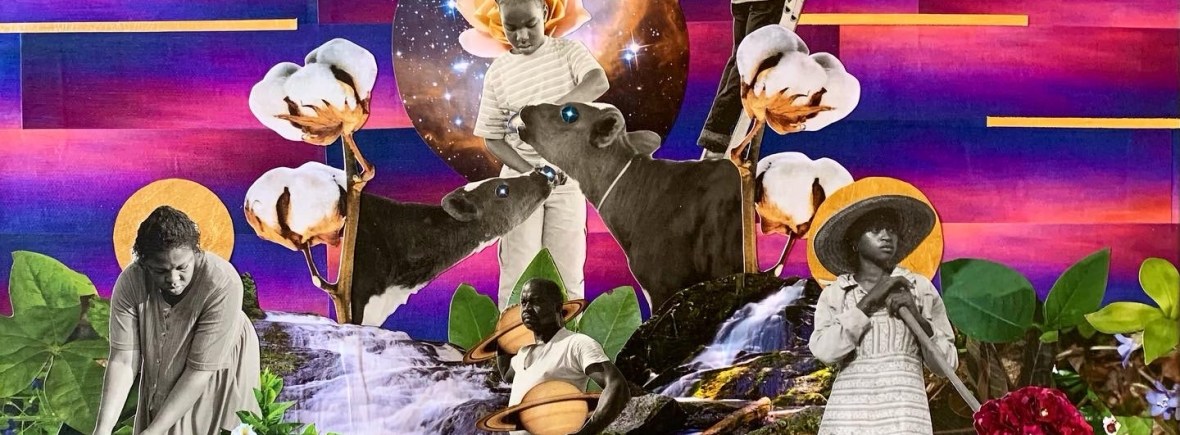
A short story by Nancey B. Price (inspired by the original collage of the same name)
Mama told me that Daddy planted seeds and harvested stars for a living. That every morning, he’d put on his giant moon shoes and become an astronaut soon as he stepped outside. In the Spring, he’d bounce around in the dusty, crimson soil by our house. And by Fall, he’d come home in the evenings with a bucket full of stars and hand it off to Mama, who’d then turn around and make magic out of things that should only exist in the sky.
Grandaddy used to do the same thing back when he was living. But instead of harvesting stars in his moon shoes, Grandma said he used to dig up planets with his bare hands. And if the harvest was plentiful that year, they’d both celebrate by picking out the biggest, prettiest planet of the crop, tossing it above their heads and watching it float off until it became a tiny dot of light in the night sky.
I tried planting my own stars once.
One day when I was a little girl, I found myself going outside one warm summer evening wearing my own moon shoes and toting a mason jar. I trekked down to the side of the yard that bordered Daddy’s starfield and I stopped once the first lightning bug floated into view. Then, as if moving in zero gravity, I slowly sandwiched the little creature between the mouth of the jar and its lid.
I repeated this capturing with other lightning bugs around me until the jar was brimming with twinkling constellations. Then, like Neil Armstrong on the moon, I bounced across the yard until I landed by the front porch steps.
I recalled what Mama taught me about gardening: dig a shallow hole, plant the seed, cover the hole, water the soil.
And I did just that.
Dig the hole.
Plant the star seeds.
Cover the hole.
Water the…
Water!
I’d forgotten the most important thing!
In haste, I shot over to the hose on the side of the porch and turned the faucet with all my might. The water I needed came rushing out in a fury! And with a life of its own, the green hose was suddenly dancing in front of me, spraying in all directions. My mason jar crashed to the ground. The lightning bugs I’d collected swiftly flew away and I was left alone, screaming against the water splashing in my face.
Having heard my shrieks, Mama and Daddy crashed through the front door and at the speed of light, they were both by my side. Mama swiftly tucked me in her arms and shielded me from the onslaught as Daddy fought with the hose until the water stopped.
The three of us were soaked from head to toe–water dripping from Mama’s curls, Daddy’s beard and the lid of the empty mason jar still cradled in my hand.
Daddy looked at Mama.
Mama looked at me.
And I looked to the ground by the porch steps. One by one, the little star seeds that I’d planted crawled up through the loose dirt that filled the shallow hole, and flew away.
That’s how I learned you can’t make stars out of lightning bugs.
Lucky for me though, this wasn’t the only lesson I was taught that day. Prior to my ill-advised attempt to bury those innocent creatures alive, I’d been begging Mama and Daddy forever to teach me how to do what they do. How to use their hands to make magic from what they planted in the soil. How to harvest the things I saw when I looked up beyond the treetops.
They’d always tell me I’d learn one day when I was older and “more seasoned.” That I had to keep on living and first tend to the seeds that were already planted inside of me.
Whatever that meant.
But that did nothing to stop my determination to figure out how to harvest my own celestial objects—with or without them. And recognizing they could no longer kick the can down the road, my parents finally relented.
Later that evening, around dusk, after I changed into drier clothes, Mama, Daddy, and I walked back toward Daddy’s starfield. We passed the flaccid water hose and the empty hole I had dug in the ground. Lightning bugs drifted around us like planets in orbit, while stars slowly began to peek through the blue-and-indigo sky above our heads. In the distance, I could see my grandparents’ lonely trailer—its windows forever darkened, emptied of the light and life they once held.
The planets they harvested hover in the darkening sky above the old tin roof. I stare at them in wonder, excited to finally learn how to pull my own Jupiters and Saturns out the ground; but sad Grandma and Grandaddy wouldn’t be able to witness my miracle.
Mama taps my shoulder, pulling me away from my celestial harvest and back down to Earth. Holding a pile of fuzzy little cotton seeds, she carefully places four of them in my hand and tells me to follow my daddy.
Ahead of me, Daddy uses his index finger to poke a line of shallow holes into the soil. I scurry close to him, holding the cotton seeds tightly between my palms.
Under my breath, I recite the mantra: dig the hole, plant the seed, cover the hole, water the soil. I rush to throw a seed in each hole he’d dug, but he stops me before I can, instructing me to wait for my mother to approach with a pail of water.
Excitement bubbles up inside of me. And once Mama arrives, I’m practically singing the mantra out loud as Daddy whistles along to the melody:
“Dig the hole.
Plant the seed.
Cover the hole.
Water the soil.”
“You forgot one important thing,” Mama says as she turns to smile at my daddy. He smiles back at her, then turns to me.
“You gotta say their names when you drop the seed,” he adds.
“Whatchu mean,” I ask, “whose names?”
“Our people,” Mama answers, “our parents, your grandparents, their parents, all our loved ones. You gotta say their names while you plant for the magic to work.”
“But what if I don’t know all their names?”
“Then say how you feel,” Daddy adds, “they’re present in our feelings too you know.”
I fall silent.
Briefly.
Then look, again, to the twinkling lights above my grandparent’s trailer. “Willie and Mary Ella,” I start as I drop one seed into the soil. Daddy covers the seed and Mama follows with a sprinkle of water.
I step to the next hole.
“James and Thelma,” I say as another seed tumbles from my fingertips. Daddy covers. Mama waters.
We repeat the planting with the names I remember. Lily. Ed. Nancy. Robert.
My throat tightens and I fall silent. Mama kneels beside me and caresses my back and I struggle to speak.
“Name the feelings,” Daddy reminds me. I clear my throat and continue.
“Sadness. Alone.”
Cover. Cover.
Water. Water.
My eyes tingle, and I squeeze them shut. I try to concentrate, believing that crying over dead people would stop the magic from working. I want it so badly to work—so I can harvest like Daddy and make like Mama.
But that didn’t stop my tears from falling like rain. And before I know it, I’m in my daddy’s arms lamenting my grandparents, unharvested stars, and the magic I couldn’t wield.
That night, after Mama wiped away my tears and Daddy stored my moon shoes in the closet next to his, I have a dream that shakes my world to its core. In this dream, I am riding in an old wooden wagon among a pile of planets of various sizes and colors. It’s nighttime. But the sky is a sea of blues and indigos with stars that float in its ripples. The wagon is moving by itself–bouncing along a rocky path beneath tree branches that reach in all directions above my head. The planets around me are whispering to me in voices I recognize, but in languages I do not understand.
Soon, the wagon stops in front of my grandparents’ trailer. The windows are glowing hues that mimic the night sky. The front door opens, and the twilight colors inside illuminate silhouettes of Grandma and Granddaddy. Together, they approach me with smiles cast across their faces as radiant as the sun.
The whispering planets fall silent.
I watch in awe as my grandparents glide across the yard, hands outstretched to me. As they reach the wagon, together, they grab my small, round body from the pile of planets and toss me into the air. They look upon me with pride as I float away beyond the trees, through the clouds, transcending the Earth’s atmosphere.
Onward to the stars.
To the stars.
 NANCEY B. PRICE